Twin screw · two-stage · triple screw · pelletizing
Your material, our line: compounding and pelletizing from 1 to 4,000 kg/h
Kerke is a twin screw extruder manufacturer in Nanjing, building co-rotating twin screw extruders, two-stage lines and pelletizing systems for masterbatch, engineering plastics, cable compound, recycling and food — and proving the output on your own material before you order.
In short: Kerke builds co-rotating twin screw extruders in Nanjing, from the KTE-20B lab machine to the 135D production line — 1 to 4,000 kg/h across single screw, twin screw, triple screw and two-stage configurations. Torque ranges from 2×720 N·m on the KTE-65 to 2×1,530 N·m on the 65D. Each line is configured from the material and the target output, test-run on 25–50 kg of your compound in 3–7 days, and delivered in 30–45 working days for standard builds.
Applications first
Start from the material you sell, not from the machine
Ten material groups, 32 application lines. Each page carries the loading ceiling, the parameter table, the process, the equipment and the mistakes that cost the most.
Plastic Masterbatch
Filler, colour, black, white, talc and functional masterbatch lines — the highest-volume application group, and the one where the filler percentage de…
Plastic Modification
Filled, reinforced, toughened, grafted and reactive systems. Side feeding, liquid injection and devolatilization are what separate these lines from a …
Engineering Plastics
PA, PC, PBT, ABS, alloys and glass-fibre reinforcement — drying discipline and fibre protection decide the result.…
Cable Compound
PVC, XLPE and HFFR / LSZH compounds. Heat sensitivity plus water sensitivity rules out most standard pelletizing answers.…
Biodegradable & PLA
PLA, PBAT and starch blends — a 30 °C processing window and a hard moisture ceiling.…
Thermoplastic Elastomer
TPE, TPU, TPR from 30A to 90A: oil dosing, underwater cutting and hardness control.…
Specialty & Low-Temperature
EPP base resin, WPC, powder coating and hot melt — processes that run cold, wet or highly filled.…
Recycling & PET
Film, bottle flakes and regrind. The largest customer group we serve, and the one where feeding decides output.…
Long Fiber & Composites
LFT-G impregnation, 20–60% glass, pellet length 10–25 mm.…
Food & Plant Protein
Puffed snacks and textured vegetable protein on the same twin screw platform, with food-grade documentation.…
Then the machine
Sized by torque, not by tonnage
The same screw diameter can carry 78% more torque. That difference decides whether a line holds 88% filler or stalls at 84%.
| Family | Range | Scope | Key column |
|---|---|---|---|
| Co-rotating twin screw KTE | 15 models | 80–4,000 kg/h, B and D Gearboxes | Output (kg/h) |
| Two-stage KTE/SE | 4 models | Stable Output at 85–90% Filling | Typical product |
| Triple screw KTE-T | 4 models | Better Dispersion in a Shorter L/D | Note |
| Kneader compounding extruder | 3 models | Kneader + Single Screw, 100–1,200 kg/h | Typical product |
| Single screw SE | 8 models | 100–2,000 kg/h, Lowest Cost per kg | Output (kg/h) |
| Lab & pilot twin screw | 6 models | 1–150 kg/h Trial & Small Batch | Output (kg/h) |
| Pelletizing systems | 7 models | Water Ring · Strand · Underwater · Air-Cooled | Watch out |
Full model index on the machines hub.
Why customers switch
Four things that are hard to copy
See it in person
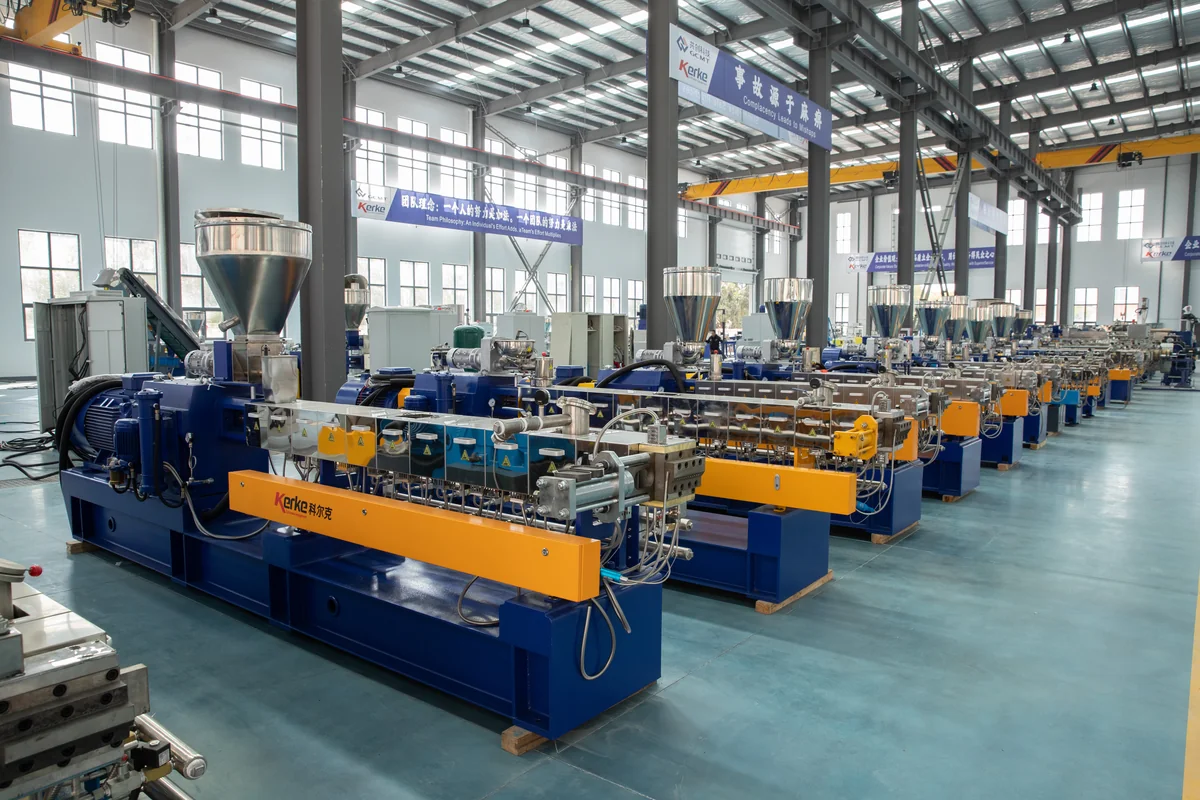
A look inside the Kerke factory
Full factory walk-through: screw element machining, barrel manufacturing, line assembly and wet-run testing.
Kerke builds co-rotating twin screw extruders, two-stage lines and pelletizing systems in Nanjing, China. Every machine is machined, assembled and wet-run in our own plant before shipment — this video walks you through exactly where and how.
- 17 years of extrusion engineering since 2009
- 2,000+ sets delivered to 70+ countries
- In-house machining of screw elements and barrels — wear parts never wait on a third party
- Every line tested with your material before it ships; 3–7 days standard trial
Next steps: Get a quote · Send material for a free trial · More about Kerke
Proof, not promises
Certificates & compliance
Kerke runs a certified management system covering quality, environment and occupational health & safety, and both extruder lines carry CE conformity under the Machinery Directive. Click any certificate to view the full document.
 CE · Twin screwMachinery Directive 2006/42/EC
ECM · Type-examination certificate
 CE · Single screwMachinery Directive 2006/42/EC
Integra96 · Valid to 2030-05-22
 ISO 9001:2015Quality management
Cert. no. 38125Q0308R0S · Valid to 2028-08-05
 ISO 14001:2015Environmental management
Cert. no. 38125E0143R0S · Valid to 2028-08-05
 ISO 45001:2018Occupational health & safety
Cert. no. 38125S0119R0S · Valid to 2028-08-05
Before you ask
Eight questions we answer every week
What is the difference between a twin screw and a two-stage line?
A twin screw melts, mixes and builds die pressure on one shaft. A two-stage line splits the jobs: the twin screw compounds and devolatilizes, a single screw builds pressure. Above 85% filler, or with PVC and HFFR, the split keeps output stable — on one shaft, mixing and pressure build-up compete for the same torque.
How do I know which model I need?
Start from the material and the target output, then the torque class, then L/D. A 65 mm screw exists as KTE-65, 65B and 65D with 2×720, 2×860 and 2×1,530 N·m — same diameter, very different capability. We quote the model and the alternative, with the trade-off written down.
Can you run my material before I order?
Yes. Send 25–50 kg; we run it on KTE-20B or KTE-36B and return pellets, a running video and a report with temperatures, screw speed, feeder settings and output per hour. The trial is free — you cover the freight. Turnaround is 3–7 days.
What is the delivery time?
30–45 working days for standard configurations, 45–70 for custom screw geometry or ODM work. Machines are built for the destination voltage and frequency, and test-run with material before shipment.
Do you supply spare parts after delivery?
Screw elements, shafts and liners are machined in our own workshop, so standard sizes ship in 24–48 hours. Every line is delivered with a recommended spare set for the wear zone.
Where are the machines built?
In Nanjing, China. The plant builds screws, barrels and assembly in-house, which is why wear packages can be specified by material rather than picked from a catalogue.
Which materials can the line run?
Five groups carry most of the work: masterbatch (filler, colour, black, white, talc), engineering plastics and modification (glass fibre, flame retardant), cable compound including PVC and HFFR, recycling and regrind, and food or pet food. Each group has its own loading ceiling and screw configuration, written on the application pages rather than guessed per enquiry.
How is the screw geometry matched to my material?
By feeding zone, mixing zone and pressure zone separately. Fillers above 60% need a longer dispersive section and a wear package specified by filler type; shear-sensitive compounds such as PVC need a shorter, milder geometry with the pressure stage moved to a single screw. The configuration is fixed on the trial bench, and the screw set that produced your pellets is the screw set that ships.
Send 25–50 kg and we run it on our lab extruder: pellets, running video and a capacity report back in 3–7 days.
Twin screw extruder manufacturer: what the specification decides
Short answer: the line is chosen by torque class first, then L/D, then screw geometry — diameter alone says little. A 65 mm screw is built as KTE-65, 65B and 65D at 2×720, 2×860 and 2×1,530 N·m, so one barrel size covers three different duties.
- Output is measured, not quoted. The ranges on this page come from trial runs on Kerke’s own line in Nanjing; the number you compare is the number produced on your compound.
- Trial before order. Send 25–50 kg and the run happens on KTE-20B or KTE-36B, returning pellets, a video and a report in 3–7 days. The trial is free; freight is on the buyer.
- Delivery. 30–45 working days for standard builds, 45–70 for custom screw geometry or ODM work, every machine test-run with material before shipment.
Where this does not apply: a grade that is not in the tables usually needs a different screw set rather than a different machine. Send the grade and the closest configuration comes back with the wear package priced as a separate line.
Related on this site: Machine range: KTE-50B to 135D · Pelletizing methods compared · quotation and free trial · Wikipedia: Masterbatch